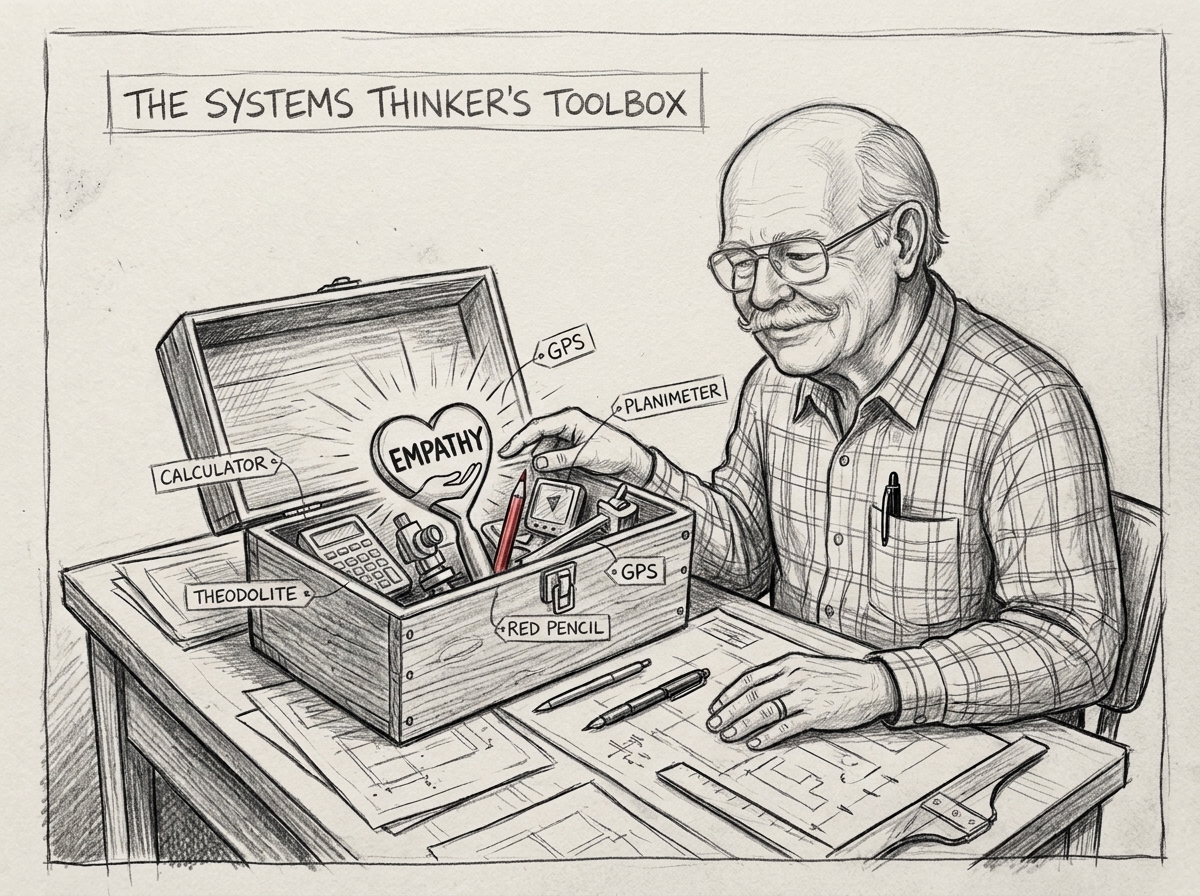
When you think about the tools you would need to build and maintain critical systems, you think of the technical ones: the calculator, the planimeter, the theodolite, the GPS receiver, the algorithm, or an engineer’s trusted red pencil. Whether we are civil engineers, economists, software architects, operations leaders, or policy designers, we are trained to believe our impact lives inside our technical implements.
I wanted to be an engineer to improve the world around us—for our fellow humans and, in some cases, our fellow living things. The ideal engineer in my mind could move effortlessly from boardroom to design room to the most grueling field conditions and master complex equations as easily as an executive conversation. Still, I believed—hook, line, and sinker—that those technical tools were all I needed in my toolbox.
A few years on and thousands of miles away in Northern California, I came across that same ideal in Duane Butler (my mentor’s mentor), one of the founders of the firm where I later worked. Duane was a true veteran of the World Bank’s landfills and waste systems worldwide. He had beautiful handwriting, was at home in any situation (boardroom, design room, or the jobsite trailer), and always had a pen in his shirt pocket.
At first, I just hoped to work with him long enough to get his signature on my CA PE license exam application. Honestly, it was just for his signature (I was a fanboy!). I jumped at the chance to work with him on a couple of projects just for his signature. Duane ended up giving me so much more than a signature (I wish I’d gotten a picture with him or saved a copy of his signature). He showed me what it really means to be a systems thinker.
I am even more convinced now that every critical system (particularly infrastructure systems) is built upon three interlocking pillars: the technical, the social (the political being part of that), and the legal. The glue that holds them together isn’t the technical.
It is empathy!
Beyond the Blueprint: System 1, System 2, and Sympathy
Even the most experienced systems builder will find themselves missing the human element when it comes to whether a system will actually work or just sit there. Thinking, Fast and Slow (2011) by Nobel laureate Daniel Kahneman provides a useful lens through his System 1 and System 2 model. System 1 works automatically and quickly. It is driven by the visual world, daily routines, and WYSIATI (What You See Is All There Is). System 2 is slow and deliberate. It lets you step back and actually see what the other person sees.
I think System 2 thinking is what separates us from AI systems—that is a topic for another day.
When we design or modernize systems, we are almost invariably operating in System 1. We draw our boundary at the screen: the equations, the dashboards, the permits, the checklists. Because the math works, we are convinced the system is complete. WYSIATI.
True systems thinking requires you to override that shortcut with System 2 via empathy. Empathy is not sympathy.
Sympathy is passive and detached. It’s feeling for the person from behind a spreadsheet. You know they’re in a difficult situation; you know the job they’re doing is tough, but you don’t actually get into their reality. Empathy is active. It’s rigorous inquiry. It’s feeling with the person. It’s putting yourself in their shoes and really trying to understand the constraints they’re operating under and the feedback loops that are at play in the system. In complex systems work, sympathy is like sending a gentle memo from HQ. Empathy is the one that actually gets in the cab.
What Duane Learned in the Cab of a Garbage Truck
Duane learned this on a World Bank-funded garbage collection project he designed end to end. Alongside intricate landfills, permitting, and construction, he built the routing network using complex graph-theory algorithms to find the optimal paths. His team incorporated citizen needs and delivered best-in-class engineering.
It worked initially—it replaced nothing with something. Within a few weeks, though, performance was well below what it could have been. Duane went back to the drawing board, re-optimizing the schedules, logistics, and demographics—all for very modest improvement. Interviews with the managers and operators revealed no real problems.
Refusing to accept that “that was all there was” in terms of what he saw, Duane stopped with the technical fiddling and got in the garbage trucks to ride with the drivers.
Sitting in that passenger seat shattered his assumptions. Previously, he had met the drivers at the landfill and learned they were sharp—they had helped build the new system and grasped operational needs effortlessly. However, as Duane got to know them, he uncovered a reality no stakeholder survey had surfaced: many drivers and operators lacked access to formal education and had minimal reading capacity. Duane’s empathy unblocked a problem.
Duane realized he had designed with empathy for the recipients (the citizens receiving the service), not the operators delivering it. Optimal graph-theory routes completely fail when they are trapped in a dense text manifest.
He went back to the drawing board in quite literal terms and worked with the team to turn the instructions into visual, symbol-based guides—an IKEA-style manual long before IKEA had made visual instructions the universal shorthand for clarity. Performance shot through the roof.
Sharpening the Tool
Duane could have shared any of the plethora of technically impressive projects with me as a lesson, but this was his most important lesson. And I am grateful for it! I share this hoping we carry Duane’s lesson forward today, both in engineering and as I advocate for modernizing infrastructure delivery. Whether stewarding public utilities, deploying enterprise technology, or transforming organizational workflows, no technical upgrade survives contact with a human system it fails to understand.
Empathy is not a soft trait you check off once; it is a load-bearing skill foundational to every systems thinker’s toolbox, and it dulls unless we keep sharpening it—for both the people our systems serve and those who keep them running. Next time a complex system underperforms, resist the urge to tweak only the algorithm. Step outside your mental anchor, cross the blueprint boundary, and climb into the truck. Let us improve the world by making that uncomfortable journey in the metaphorical garbage truck cab.
Reference
- Kahneman, D. (2011). Thinking, fast and slow. Farrar, Straus and Giroux.


Leave a Reply