Autodesk 2020, Class ID: 467447 Anand Stephen, CME, PE Gannett Fleming
This post provides a synopsis of Anand’s Industry Talk scheduled at the 2020 Autodesk University. It charts our journey, at Gannett Fleming, moving from MicroStation to Civil 3D. In essence, it is a paradigm shift: from 2D Drawing Centric to a 3D Model Centric Approach. He recounts our digital transformation story by focusing our two hidden gems: (1) our people and (2) our data.
A paradigm shift entails changing theoretical perspectives and adjusting practices accordingly. Imagine the effort involved in convincing astronomers to change their view from a geocentric to a heliocentric planetary model. From Thomas Kuhn’s text, The Structure of Scientific revolutions, work, societies resist paradigm shifts. Further, Kuhn informs us that a new paradigm overcomes friction and becomes the dominant paradigm with time.
Outlined in the talk are strategies that helped us overcome friction due to the paradigm shift. Notably, before implementing these strategies, we ensured an empathetic environment where we considered and addressed several perspectives from multiple vantage points.
Transformation Strategies: MicroStation to Civil 3D
We took a three-pronged approach to navigate the paradigm shift successfully. A surveying instrument is a useful metaphor to consider. For a surveying instrument to work with precision, we must pay attention to the tripod’s three legs. Similarly, we paid attention to three facets necessary to enable the change from a 2D-Drawing Centric (2DDC) to 3D-Model Centric (3DMC) Approach: (1) Facilitate Leadership Commitment, (2) Develop a cohesive educational framework, and (3) Pragmatic Technical Implementation.
Facilitate Leadership Commitment
From Business Leaders’ vantage point, an organization facing competing pressures of current needs and future goals. Making a conscious paradigm shift requires an exact blueprint. Like any well-crafted map, the roadmap should identify potential routes and obstacles along the way to the destination. It should include a comparison of current and future paradigms. It is critical to provide business leaders a blueprint to make decisions balancing current and future needs.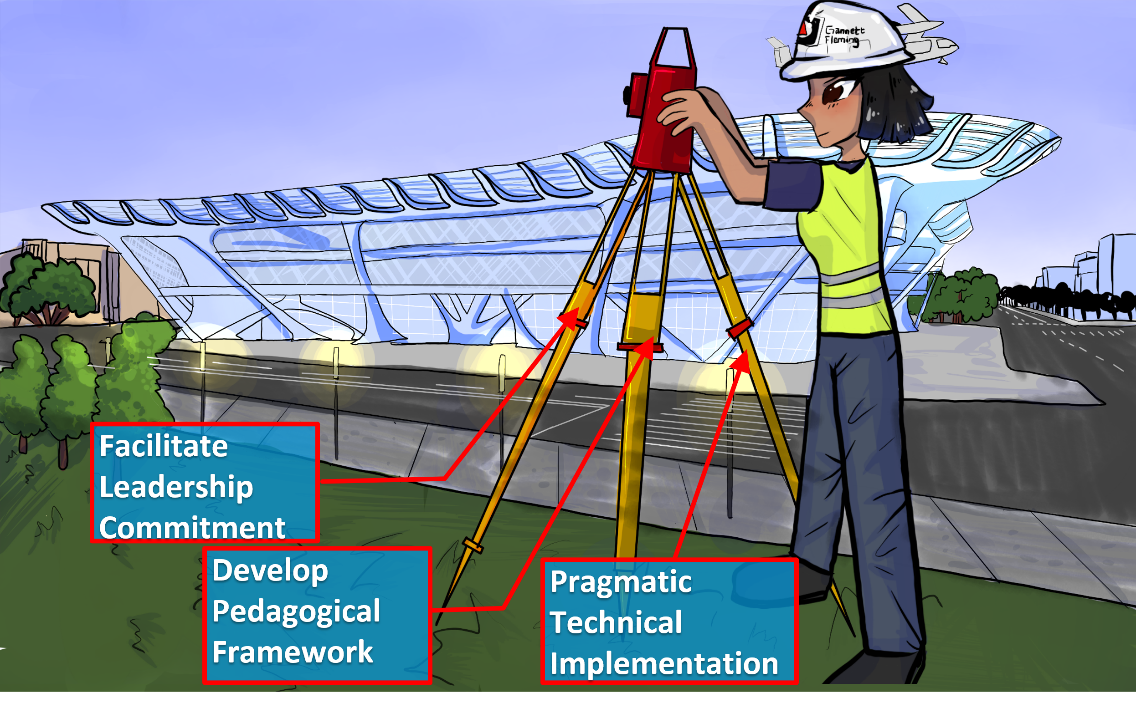
Comparing the two paradigms allows Business Leaders to see how different processes impact current business needs and future goals. Further, a Decision Matrix located various tasks in four quadrants based on effort, reward, and priority. It provides additional detail to the roadmap on how a firm could accomplish different tasks. These crucial data points give the leaders a roadmap, which empowers them to make the best decision.
Establish a Pedagogical Framework
Technological change is inherently an angst producing activity. Hence, acknowledging human emotions is essential to adopt change effectively while maintaining productivity. Creating an empathetic milieu was necessary for the journey since many change adopters were in different locales. Finally, importantly, it aligns well with our work culture at Gannett Fleming. 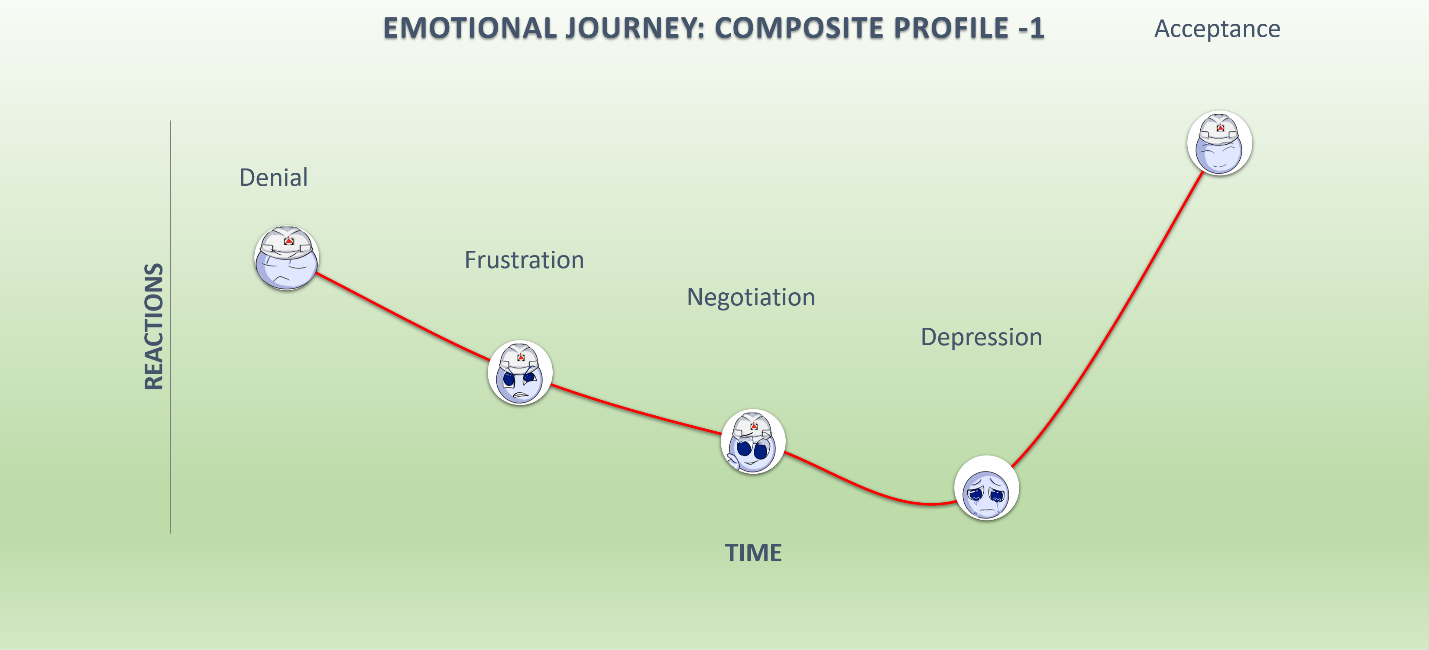
The critical point is that it is unwarranted to accept every opinion. However, it is essential to respond to various perspectives. We responded to concerns by relying on data, research, and best management practices recommended by Autodesk.
Early in our journey, we realized that a single pedagogical approach would not work for our diverse group. Our team members brought varied skill levels and had different ways to process and learn new knowledge. Moreover, listening to our peers confirmed that we needed to formulate a pedagogical approach that maps educational methods and abilities.
Creating a cohesive educational framework within an empathetic environment has significant advantages. From a functional perspective, a coherent educational framework reduces friction due to the shifting of paradigms. It makes upskilling a smoother process. Any change, let alone acquiring skills to adapt to that change, is a fraught process for people. Hence, for an efficient paradigm shift, we should create a coherent educational framework within an empathetic environment. It enables the teams to hear and react to various users’ perspectives.
Establish a pragmatic technical approach
A pragmatic technical approach is crucial in moving from a 2DDC to a 3DMC system. It is one of the three legs of the tripod essential for empowering the paradigm shift. The operative word is “pragmatic.” We do not live in a world with unlimited resources.
We establish a practical technical approach by adhering to foundational data management concepts from Information Systems Design and following a practical approach towards content creation. The two are not mutually exclusive.
In Information Systems design and theory, a Single Source of Truth (SSoT) refers to organizing data and metadata to avoid data redundancy. Every data element is stored exactly once. By avoiding data duplication, SSoT ensures data consistency. In a 2DDC approach, often, there are multiple sources of truth. For example, designed grades are noted in a design file and subsequently copied over to the sheet files. The potential for data duplication creeps into the project. The problems associated with data duplication increase exponentially with project size.
Data Encapsulation is the concept that extends the SSoT concept. The internal structure and representation of the data are hidden from sources consuming the data. Following data encapsulation, you can organize data by user roles.
Conclusion
In the Industry Talk, Anand recounts our journey of moving from one paradigm to another using Civil 3D; it is a story of changing our peers’ theory and practice. The three strategies that our story rests on are: (1) facilitating leadership commitment, (2) formulate an educational framework, and (3) implementing a pragmatic technical approach. Importantly, before embarking on the paradigm shift, we ensured to foster an empathetic environment — where we considered and addressed change adopters’ perspectives. Understanding the views of our peers helps reduce friction that paradigm shifts typically encounter.
References
1 Kuhn TS. 1962. The Structure of Scientific Revolutions: 50th Anniversary Edition.
2 Oswald AJ et al. 2015. Happiness and productivity. J Labor Econ University of Chicago Press Chicago, IL. 33:789–822.
3 Achor S. 2011. The Happiness Dividend. Harv. Bus. Rev.
Credits
-
- Graphics: Sophia Stephen, Indigo Digital Art, http://www.indigodigitalart.com/
 Infrastructure Tales
Leave a comment